

Yes, product recommendation chatbots can help an ecommerce business when a short exchange clears up a buying decision. The opportunity is to help shoppers choose a suitable item, understand a tradeoff or resolve the question keeping them from buying. The conversation has to earn the effort it asks from them.
Upsello is worth evaluating for that job because its shopping assistant connects product guidance with relevant additions, answers to buying questions and access to human help. The useful question is what this would change in your store. Start with one recurring choice problem, ask to see how the flow handles it and judge the result against the experience shoppers already have.
When recommendation chat earns the shopper's effort
Chat is worth considering when the next useful answer depends on something the shopper has yet to explain. “Which lamp suits my crowded desk?” leaves room for clarification. “Where is the size filter?” points to a navigation problem. Fixing the page may be the better first action.
Use the buying question to choose which route to evaluate:
| Shopper situation | Useful route | What to check |
|---|---|---|
| The criteria are clear. | Product information, filters or a recommendation block. | Can the shopper reach a suitable item directly? |
| Most choices use the same few criteria. | A short structured quiz. | Do its answer choices cover the real buying questions? |
| The requirements are unclear or change with each reply. | A conversation. | Does the next question change the choice enough to justify answering? |
| A deciding fact is missing or needs judgment. | A person with the relevant information. | Can the shopper reach the right help without repeating unnecessary steps? |
A product block may already use dynamic recommendations. Chat's distinct contribution is the exchange around the choice. For a simple related or complementary product, Shopify's supported product-page sections may provide a direct route. Shopify recommendation options
Look at the questions your shoppers actually ask before selecting the interface. If the answers simply repeat a product field, make that field clearer. If the answer changes after a shopper explains a need, there is a more useful conversation to explore. Its value lies in resolving that uncertainty with a sensible amount of effort.
How Upsello can help a shopper choose a product
Upsello describes recommendations informed by shopper questions, browsing behavior and purchase intent, with explanations of fit and tradeoffs. That is a capability to assess through a specific product choice, rather than a reason to accept any fluent answer. Upsello's product guidance
Consider a hypothetical desk-lamp shopping scenario, not an actual Upsello conversation. A shopper needs a lamp for a crowded desk, requires it to work with their existing power arrangement and prefers a brass finish. These details have different roles. Space and power determine whether an option is usable; finish helps choose among options that already fit.
“Crowded desk” leaves a useful question unanswered. A deciding follow-up would be: “How much space can you spare for the lamp's base?” Asking for that detail can change the shortlist. Asking about finish again leaves the shopper with the same fit uncertainty they brought to the conversation.
The merchant should judge the next reply by what it makes possible. Once the available space is clear, the flow can compare it with the recorded base dimensions. Power requirements need their own check against the product information. A matching finish should then influence the order of the suitable choices, rather than hide a size or power mismatch.
At this point, a useful response explains the choice in the shopper's terms. It should identify which option fits the stated space, whether the preferred finish is offered and what relevant difference remains between the options. Saying “recommended for you” gives the shopper little basis for deciding. Explaining which requirement an item meets makes the recommendation easier to assess.
Suppose the preferred finish is unavailable among the options that meet the requirements. The next question should make the tradeoff visible: is the shopper willing to choose another finish, or do they want to reconsider the space available? That choice returns control to the shopper. It also avoids quietly relaxing a requirement to keep a preferred product on the list.
The reply matters differently depending on the answer. Accepting another finish should change the color preference while keeping the original space and power needs. Finding more room on the desk can broaden the size range, while the power requirement remains. A merchant can ask to see these branches in a demonstration and inspect whether the resulting shortlist reflects the actual change.
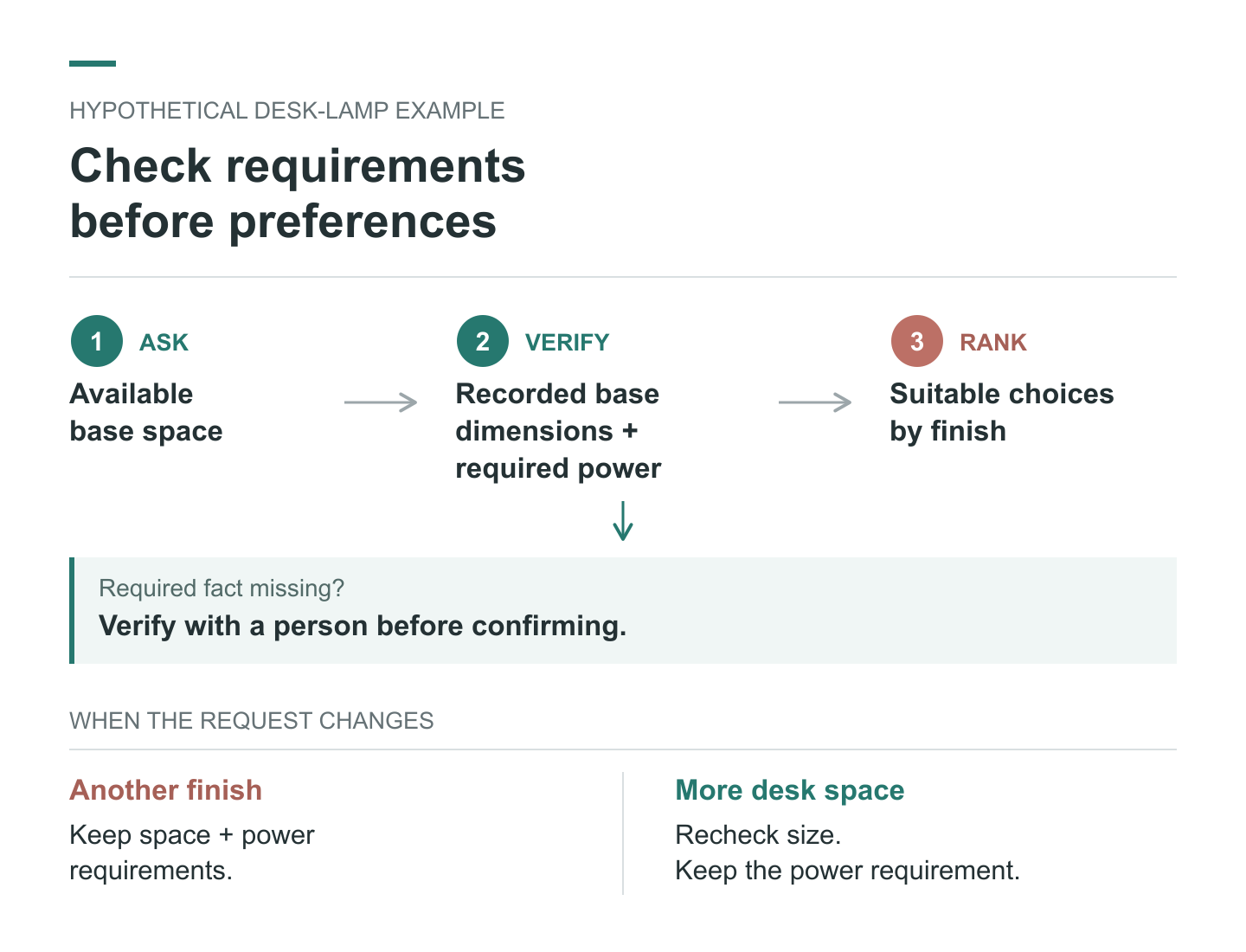
This is the commercial job of the exchange: turn an uncertain comparison into a choice the shopper understands. The product page may already contain the deciding facts, yet the shopper still needs help connecting them to their desk. The dialogue earns its place when it makes that connection with less work than another round of browsing.
Relevant add-ons, buying objections and human help
Once the main choice is clear, ask what would help the shopper use or buy it. These are optional next situations, not a script every conversation must complete.
Give an addition a reason
Upsello can suggest accessories, bundles and premium upgrades in chat. Its features page also describes behavior-based upsell and cross-sell. Documented suggestions, Upsello features
In the hypothetical lamp scenario, a cable organizer could address clutter around the lamp's power cable. Check the store's verified relationship and intended use before suggesting it. An item that consumes their scarce desk space may make the purchase less useful. Explain the connection and let the shopper decline without reopening the main choice.
Offer a bundle under approved store terms. For an upgrade, explain the difference the shopper would value. A higher price alone gives them no reason to choose it.
Answer the hesitation that remains
Upsello describes recovery help that addresses a buying objection, reminds shoppers about their cart and suggests alternatives. Upsello's recovery application
If the lamp shopper asks about returns, the useful response is the applicable policy and the condition that matters to their concern. An incentive does not answer whether an item can be returned. Use offer rules where relevant, but inspect the actual objection before making another suggestion.
Bring in a person for the deciding unknown
Upsello documents merchant guardrails, preferred wording and human handling of complex cases. Upsello's control and human-support information
If a required power detail is absent from the product record, route that specific question to someone who can verify it. Ask during evaluation what information the person receives. The goal is for the next reply to settle the unknown, rather than make the shopper restart the entire product search.
These branches make Upsello relevant to assess when merchandise choice and buying help are linked. Each branch still needs its own purpose: a useful addition, an answered objection or a person who can confirm the fact needed to proceed.
What to ask for in an Upsello demonstration
Bring a real question from your category and the approved product records needed to answer it. Ask to see the flow make the choice clearer, rather than work through a polished sequence of feature names.
Use three cases to structure the request:
- An ordinary request: Ask which fact changes the shortlist and why each shown product remains. Check the explanation against the records. A useful response lets the shopper assess a difference instead of accepting a vague endorsement.
- A changed requirement: Modify a deciding constraint, then a preference. Inspect which items change and which original requirements remain. In the lamp example, another finish should not silently change the power need. Ask the presenter to show the actual result.
- A missing fact: Remove a detail needed to confirm fit. Look for an honest narrower answer or a route to the right person. Ask what the support team would see and who owns the unresolved question.
Upsello's integration information describes escalation and offer rules and previewing conversations. Use those controls as part of the demonstration request, then inspect their behavior for your category. Upsello's Shopify workflow
Keep a short review note for each case: the deciding question, the fact supplied and the difference it made to the options. If a turn changes neither the choice nor a meaningful tradeoff, ask how it could be shortened or removed.
Also ask which records and events you could review afterward. Distinguish a successful demonstration from evidence of business value: it can show whether the proposed flow handles the task, while a pilot must establish whether shoppers use it and benefit enough to justify its operation.
Decide whether to keep, change or stop the flow
Use three views to judge the experience. Did the product choice improve? How much work did the chat create? What happened commercially? A long exchange can contain useful reasoning or repeated failure. Message count alone will not tell you which. Microsoft's evaluation guidance
Review behavior and outcomes together before choosing the next action:
| Decision | What would support it | Next action |
|---|---|---|
| Keep within the tested scope | The flow resolves deciding questions with checked facts. Shopper effort is reasonable. Business value justifies the work to operate it. | Retain the category and review the remaining failure cases. |
| Change a specific step | Repeated questions, unclear wording or a catalog gap delay a useful choice. | Fix that cause and reassess the changed step. |
| Stop or choose another route | Deciding facts remain unavailable. The flow adds persistent work or costs more than the task justifies. | Use a clearer page, simpler selection flow or human advice. |
If the evidence is too limited, hold the scope. That is not proof of a gain or loss. Set the outcome before the pilot. Check the recording and plan enough eligible traffic to assess a change worth acting on. Experiment-planning guidance
Keep choice diagnostics distinct from business outcomes. Review which shown items were suitable, whether shoppers reached a useful product or cart action, and where they corrected the answer, repeated themselves or requested a person. Ask how these checks would be recorded; they are proposed evaluation measures.
For a visitor purchase rate, count each visitor who places at least one order once. Divide that count by all assigned eligible visitors. Use the same period and rules for each group. Compare the current experience with the proposed flow through a fair assignment, preferably randomized. Chat users alone are a self-selected group. Microsoft on A/B testing
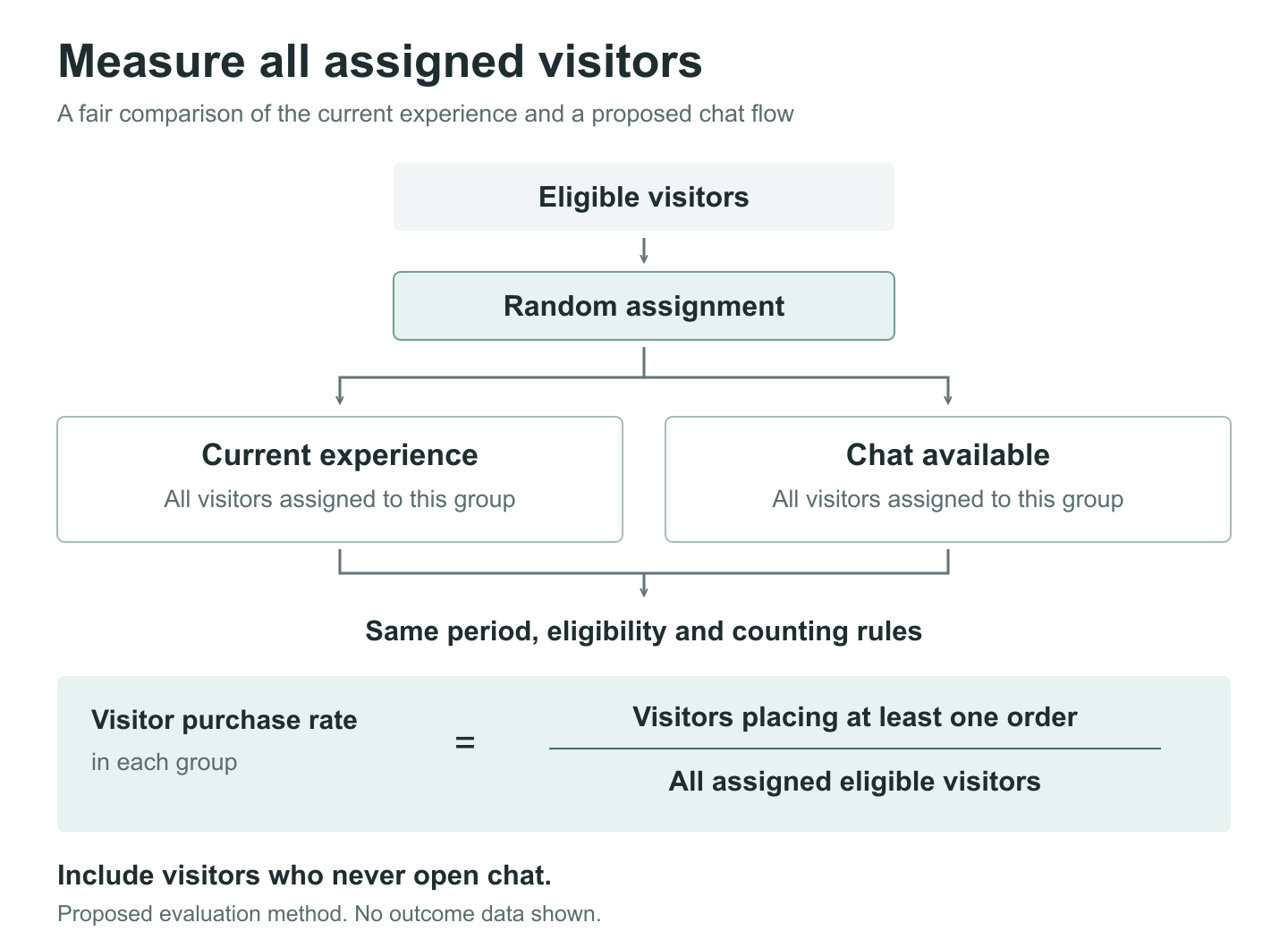
Upsello's docs name session-level conversion, recovery GMV and satisfaction analytics. Confirm their definitions and available events before interpreting them. Attributed sales help describe activity around the assistant, while added value requires the comparison above. Upsello analytics
For broader design and measurement, use the companion recommendation pillar. For full operating costs and profit interpretation, use the chatbot ROI guide. Keep this decision focused on whether the specific product-choice conversation earns its place.
Start with one recurring buying question
Choose a question shoppers already ask and identify the product fact or tradeoff behind it. Then ask whether another reply would materially improve the choice. A clearer product page may answer it; a changing need may justify conversation.
Upsello is worth discussing when that choice also involves a relevant addition, a buying objection or help from a person. Prepare your store URL, category and one representative question, then talk to the Upsello team. Use the discussion to clarify the deciding facts, the useful next action and the point where human judgment is needed.
The result should be a flow you can inspect and a decision you can measure, with a simpler route still available when it serves the shopper better.


