

TL;DR for ecommerce brands
- Conversational commerce means helping shoppers choose, buy, or get help through dialogue -- human, software, or both. Shopify's definition covers both.
- Start with the barrier behind the question (missing fact, preference choice, or exception) -- not with a new chatbot.
- Confirm the shopping result (cart, policy, delivery), not only a fluent reply.
- Judge success with contribution after incremental cost, not order count alone.
- Bring Upsello into a Shopify test only when guided selling, routine support, or recovery is the remaining job -- and catalog facts are already trustworthy.
Conversational commerce uses dialogue to help people choose, buy, or get help with a product. A person, software, or both can handle the exchange. It includes a staff member answering a product question as well as an AI assistant guiding a shopper.
For an ecommerce brand, the first decision is what needs to change before the shopper can proceed. A missing bag dimension may call for a better product page. A choice between two suitable bags may need a conversation. A return exception needs someone with authority. This guide shows how to make that distinction, verify the shopping result, and judge commercial value -- including a worked example where more orders produce less contribution.
Where conversational commerce fits
Choose the channel and the handler separately. A channel is where the exchange happens: website chat, a messaging app, text, or voice. The handler is who or what responds -- a sales adviser, fixed rules, or AI. A website inbox can stay human-led; adding a bot does not decide who answers an exception after hours. Shopify Inbox, for example, leaves conversations with staff until the merchant enables its AI agent.
The shopping task supplies the purpose:
- Discovery: turn an unclear need into a useful comparison.
- Pre-purchase: explain shipping or return conditions.
- Post-purchase: answer order questions that need identity checks and access to the customer record.
These tasks need different sources and rights, even inside one chat window.
Related terms overlap. Social commerce is selling through social platforms; a shoppable post may convert without a conversation. A chatbot is a tool. Conversational marketing uses dialogue to develop interest. A broadcast offer can invite a reply, but someone or something still has to handle that reply. Shopify's social-commerce guidance covers the platform side of this split.
These labels define scope. The operating question that matters is what the shopper is trying to resolve -- and whether answering alone can resolve it.
Start with the barrier behind the question
Treat the customer's wording as a clue, not a complete diagnosis. An abandoned cart shows that a purchase stopped; it does not name the reason. Even a clear question can hide more than one problem. "Will my laptop fit?" might mean the page lacks dimensions, the shopper missed them, or the shopper needs help choosing between compartments.
Read the exchange and check the relevant page, policy, or store record before you assign a remedy. Intercom's guidance on understanding customer questions supports clarifying intent instead of jumping to an assumed answer. The examples below apply that idea to commerce. They are hypothetical diagnostic choices, not measured customer findings.
| Question and verified condition | Useful next step | Owner |
|---|---|---|
| "Will my laptop fit with its case?" The page gives only the bag's outside dimensions. | Verify the usable compartment and opening, then publish qualified fit information. | Merchandising and product content |
| "Which bag is easier for my commute?" Both meet the size requirement but differ in weight and pocket layout. | Ask which tradeoff matters, then compare the relevant facts. | Sales adviser or guided-selling flow |
| "Can I return it after my trip?" The request falls outside the published policy. | Explain the rule and send the exception for an authorized decision. | CX team with approval rights |
| "I need it Friday." The available delivery estimate is Monday. | Check a feasible alternative or explain the timing limit. | Fulfillment or the team managing delivery options |
A clearer explanation will not create stock, shorten a delivery route, or grant a policy exception. Conversely, a fixed fact that belongs on every product page often deserves a source repair before a new automated dialogue.
Keep the diagnosis open to challenge. If dimensions are already accurate and visible, ask why they were still insufficient before you add more copy. If a shopper is balancing two suitable options, dialogue may still help. Choose the intervention that addresses the verified barrier, with an owner who can change it.
What a laptop-bag question should change
Consider a hypothetical bag store. A shopper asks, "Will my laptop fit with its protective case on?" The product page lists outside dimensions but gives no usable compartment or opening measurements. The immediate answer needs those missing facts. A longer style description would leave the purchase question unresolved.
Example (hypothetical)
Shopper: Will my laptop fit with its protective case on?
Assistant: I can see the bag's outer dimensions on the page, but not the usable compartment or opening size. I'm passing this to merchandising so we can verify fit with a case on -- rather than treating outer size as a confirmed fit.
The merchandising owner opens a specific repair: verify the outer dimensions of the customer's cased laptop, the usable space in the bag, and the opening it must pass through. Obtain reliable product information or arrange a check, then state only the fit conditions the evidence supports. Until that work is done, the handler should explain which detail needs checking and pass the question to the team. It should not treat outside dimensions as a confirmed fit result.
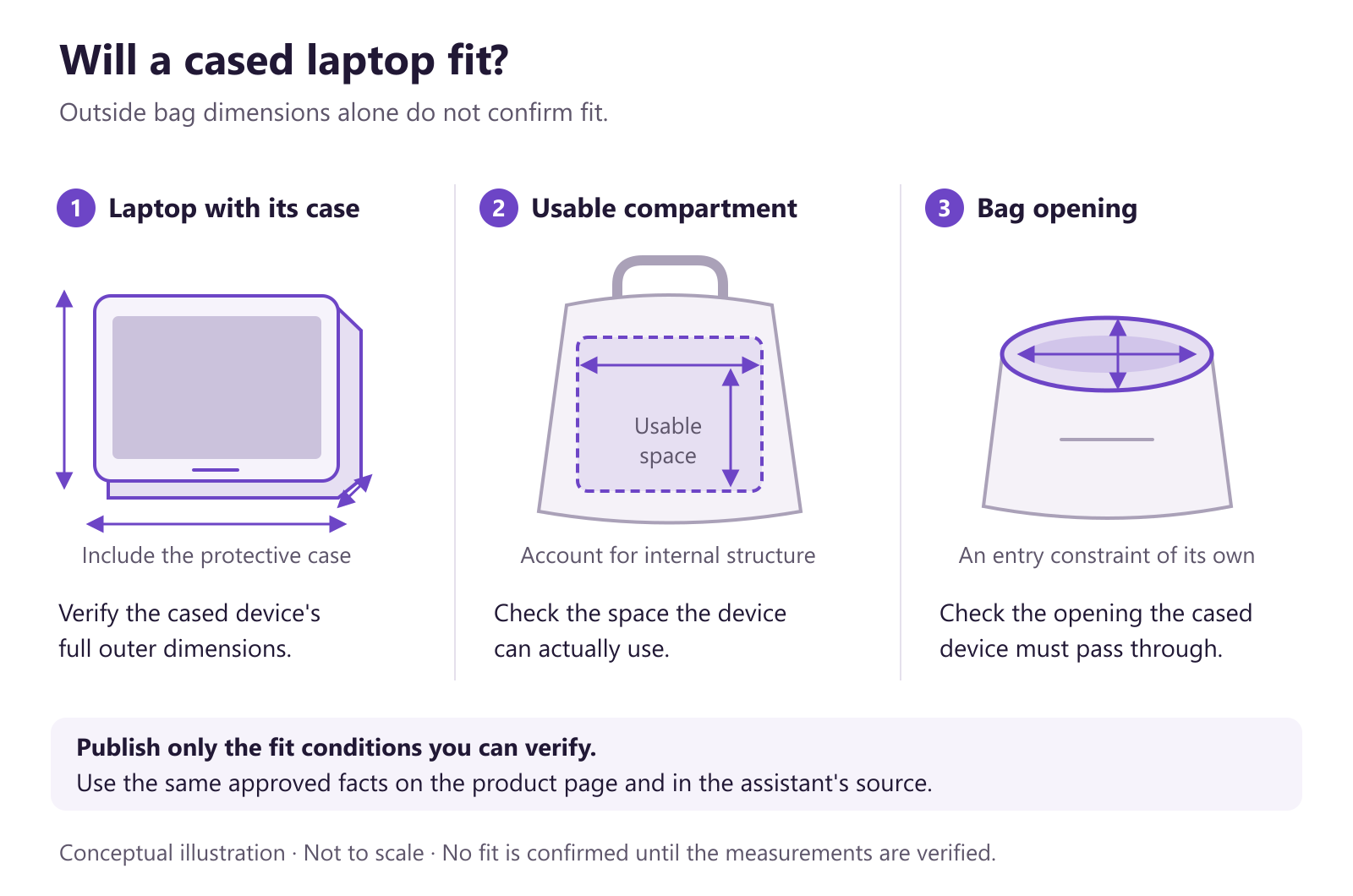
Once verified, put the facts where shoppers decide -- near size or compatibility information. Include the protective-case condition instead of an unqualified fit promise. Update the assistant's approved source in the same repair. Shopify's training guidance is clear for its agent: changing persona feedback does not change product or policy knowledge. The source itself needs correction.
Then check whether the repaired fact reaches both readers and the handler. Ask the original question again and inspect the source used. Later fit questions may concern the same missing fact or a new preference (for example, space left for other items). That distinction decides whether to repair more information or offer a comparison.
Measure same-question contact pressure (optional)
For a defined SKU and period:
- Count eligible product-page sessions.
- Count a session once if it links to at least one contact with the same coded fit question.
- Divide that second count by all eligible product-page sessions, then multiply by 1,000.
That yields a same-question contact-session rate, not a raw message count. It requires a reliable link between contact and session. Keep topic coding, linking window, tracking, and help access comparable. Check audience and device mix too. Read the rate next to purchase conversion and relevant returns. Fewer fit questions can mean the page answered them -- or a hidden chat button or weaker traffic. If questions fall while buying and return outcomes stay acceptable, the source repair may be working without creating more conversations.
Confirm the shopping result, not just the reply
A page repair will not settle every choice. In the bag scenario, suppose two options fit the cased laptop: one is lighter; the other gives easier access to work items. Asking which commute tradeoff matters can change the recommendation. That is a useful job for dialogue after fixed fit facts are checked.
Once the shopper chooses, the task changes again. Explaining an item and changing a cart require different rights. A handler should confirm only an action it was allowed to perform and whose result it has checked. A request outside its authority -- such as a return exception -- belongs with an authorized person. Define the offline route as well as the live transfer.
There is a less obvious distinction: an action request can succeed while the cart changes in another way. Shopify's cart-warning documentation shows this in a Storefront API example. The requested addition succeeds, but an item already in the cart becomes unavailable. The response has an empty userErrors array and an out-of-stock warning on that existing line.
| What to inspect | What the documented example returns | Meaning for confirmation |
|---|---|---|
| Requested addition | The requested variant is present in the returned cart. | The addition succeeded. |
| Other cart contents | A different, existing variant has quantity zero. | The rest of the intended basket needs attention. |
| Warning and errors | MERCHANDISE_OUT_OF_STOCK targets the existing line; userErrors is empty. | An error check alone misses the changed basket. |
The new item did not fail to add. The warning describes an automatic change during a successful request. Saying "Everything is ready" would tell the shopper more than the returned state supports.
For a configured cart workflow, compare returned lines and quantities with both the requested change and the contents expected to remain. Inspect warnings and explain changes that affect the intended order. A useful confirmation can state that the requested items were added, name the unavailable item, and offer the supported next step. It need not label every warning a failed action.
This is a platform example, not an Upsello demonstration. The practical lesson for evaluation: inspect the resulting shopping state alongside the reply. A fluent confirmation or a successful request, viewed alone, can miss what the customer needs to know.
More orders can still mean less contribution
Judge the commercial package by what it retains after costs that change. Shopify's contribution-margin explanation separates sales less variable expenses from broader profit measures. For this decision, calculate dollar contribution, then subtract any extra cost of running the workflow.
The figures below are entirely hypothetical. Assume two groups each contain 1,000 eligible visits over the same period. Keep product mix and other cost conditions unchanged. The $60 per order includes all relevant variable costs and allowances, including fulfillment and returns. The package gives a $10 discount on every order, not only orders credited to chat.
| Assumed input or calculation | Control | AI-plus-discount package |
|---|---|---|
| Orders | 100 | 110 |
| Revenue received per order | $100 | $90 after the $10 discount |
| Variable cost per order | $60 | $60 |
| Contribution before extra workflow cost | 100 x ($100 - $60) = $4,000 | 110 x ($90 - $60) = $3,300 |
| Extra workflow cost for the period | $0 | $100 |
| Contribution after that cost | $4,000 | $3,200 |
Orders rise by 10%, but contribution after the extra workflow cost falls by 20%. The package gives away $1,100 in discounts across 110 orders. Counting only $100 of discounts against the ten additional orders would miss most of that cost. The lower order revenue in the table already includes the discount, so do not subtract it a second time.
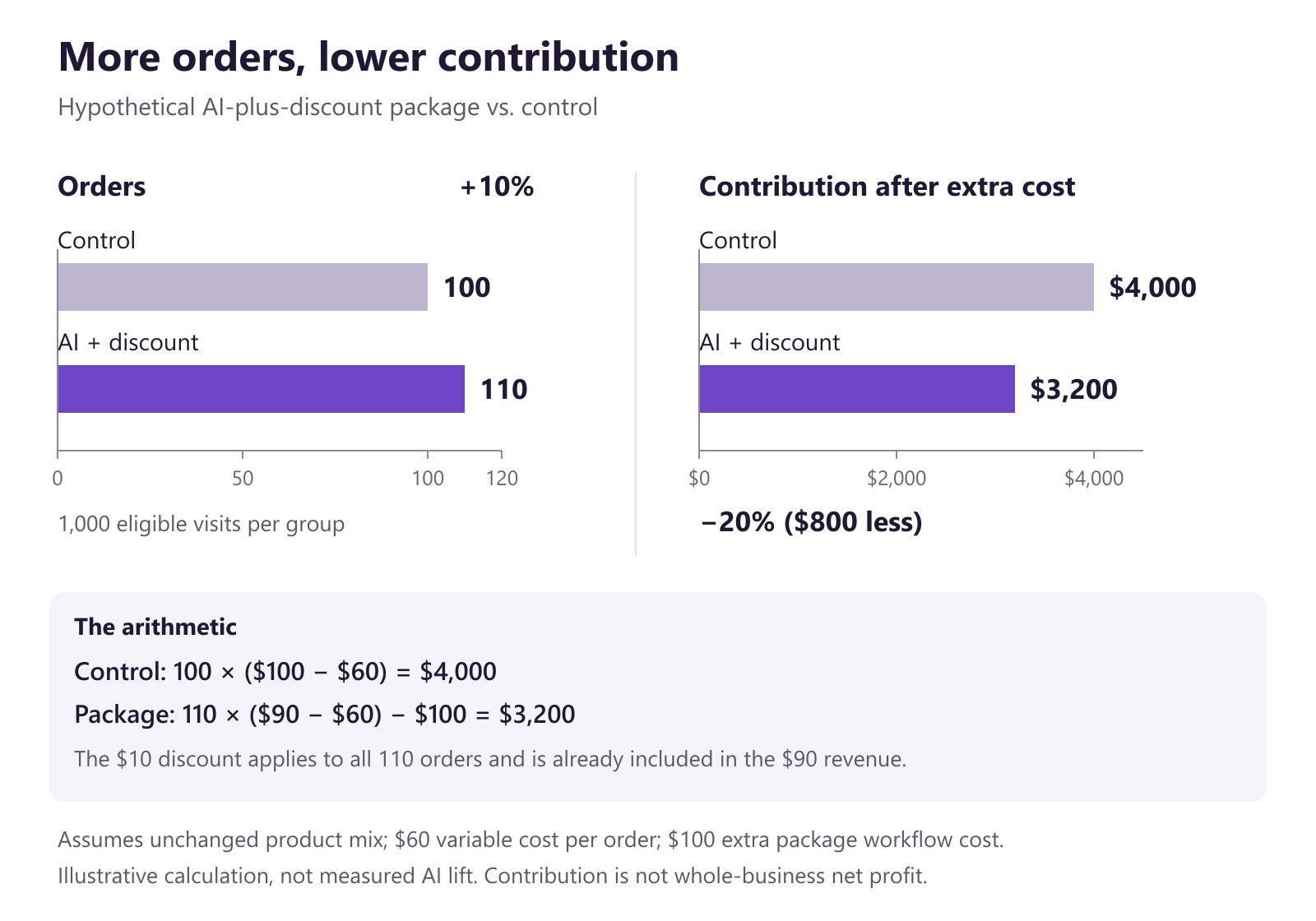
Under these unchanged assumptions, each discounted order contributes $30 before the extra workflow cost. To beat the control's $4,000, the package needs:
Orders x $30 - $100 > $4,000
The minimum whole number is 137 orders ($4,010). At 136 orders, the result is $3,980. That threshold belongs to this set of assumptions; your store needs its own prices, costs, and offer rules.
The $3,200 figure is contribution after incremental workflow cost -- not whole-business net profit. Common fixed overhead sits outside this comparison. Assistance and discount policy both changed, so the example compares whole packages. It cannot isolate an AI effect or prove a real-world lift.
Use the same discipline when you review AI chatbot pricing. Include tool usage, review, source upkeep, and staff time in the relevant workflow cost without counting an expense twice. A promising order count can justify another test; the contribution calculation decides whether the current package is worth expanding.
Choose the next intervention from the evidence
Return to the hypothetical bag store. The initial finding was a missing fit fact, so the first intervention should repair that fact where the shopper and handler can find it. Adding a broader sales conversation at the same time would make it harder to learn whether the factual repair was enough.
Fill the test decision before launch:
| Decision field | Filled bag-store example |
|---|---|
| Initial change | Publish verified fit conditions on the bag page and update the handler's source. |
| Owner | Merchandising verifies the facts; product content publishes them; CX applies one fit-question code. |
| Expected shopper result | The shopper can check the cased laptop against the usable compartment and opening, or see which fact still needs staff help. |
| Evidence to collect | Page/source version, eligible product-page sessions, linked fit-question sessions, purchases, and relevant returns under a defined window. |
| Result to inspect | Both page and reply use the approved fact. Later questions show whether a factual gap or a preference choice remains. |
Keep help access, event tracking, and topic coding stable. Compare the same SKU under comparable traffic and device conditions. A before-and-after result can still reflect other changes; use a suitable controlled comparison where feasible before claiming that the repair caused a sales effect. Assign comparison groups before people choose to chat, so the analysis includes eligible shoppers who never use it.
Next steps depend on the evidence:
- If the same question persists because the fact is buried, improve placement.
- If the remaining question is about two suitable options, test a focused comparison.
- If contacts fall while conversion weakens or fit-related returns rise, investigate access, traffic, and answer quality before declaring success.
Treat commerce actions and economics the same way. Check the returned basket when the flow changes a cart. If a discount package produces lower contribution, revise the offer or scope before you expand it. These are different repairs with different owners. The useful output of the pilot is a decision about which change to keep -- not a longer list of conversations the tool can handle.
When Upsello belongs in a Shopify test
Consider Upsello when the diagnosed Shopify task still calls for product guidance, routine support, or a recovery workflow. Upsello describes its AI chatbot for ecommerce in those areas. Its Shopify integration lists catalog and order context, plus settings for greetings, escalation, and offers. Those first-party descriptions give you a scope to test against a real shopper task.
For the bag store, a missing compartment measurement belongs with the product team first. If verified facts are available and shoppers still need help weighing two suitable bags, a guided-selling test has a clearer purpose.
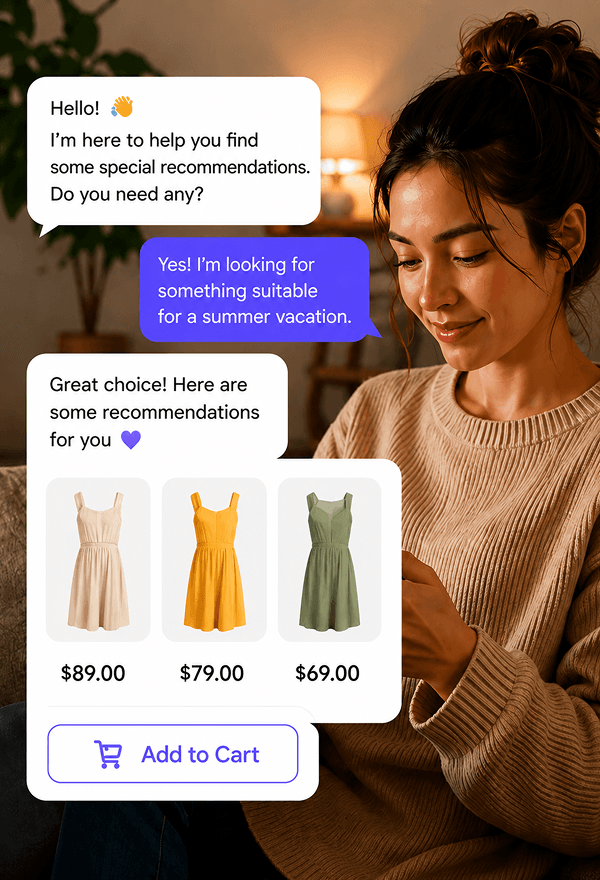
Image source: Upsello homepage (accessed 27 October 2026). Marketing illustration, not a verified live-store screenshot or evidence of sales lift; cart permissions and results still require testing.
Upsello is usually a weak fit when:
- You only need a ticket inbox and do not want guided selling or recovery.
- Catalog or policy facts are wrong or missing (fix the source first).
- Almost every request is a high-exception case that already needs a human with approval rights.
A human-led inbox may be enough for low volumes or requests with many exceptions. An existing channel tool may already cover the chosen job. Select an approach by the remaining work and the coverage it needs.
What to bring to an evaluation
- The original shopper question and an exception case
- The approved product or policy source
- The intended shopping result (including cart or offer rules, if any)
- Questions on how source changes reach the handler, where human handoff goes, and which events you can inspect
If the workflow includes a cart change or offer, verify configured permissions and the returned result. The Shopify API example above is a test question, not proof of an Upsello action capability.
On pricing, start from the live Upsello pricing page and confirm current plan limits there before you plan a pilot. Upsello states most stores can go live in under five minutes after connecting the store -- treat that as a first-party claim to verify on your theme and permissions.
Use that evidence to evaluate an AI shopping assistant for Shopify. The next step should clarify whether the configured workflow addresses the barrier that remains -- and what quality and contribution would need to show before expansion.


