

Not every store needs another AI app
No—not every Shopify store needs an independent AI shopping assistant. Start with what Shopify already provides. Add another tool only when it closes a specific gap and produces measurable value beyond that baseline.
The important distinction is between helping shoppers discover products outside your store, helping merchants operate the business, and helping visitors decide what to buy inside the store. These jobs overlap, but they are not interchangeable.
Shopify published its Fall ’26 merchant announcement on October 28, 2026. My takeaway is not that independent assistants have become unnecessary—or indispensable. It is that the bar for justifying one has moved up.
What changed: AI shopping is becoming infrastructure
The announcement connects more of the shopping journey. Shop.md lets a personal agent search products, make personalized recommendations, and check out with Shop Pay. Shop Pay is expanding into personal agents, while Universal Checkout on Shop supports carts spanning multiple merchants.
That is more than a new chat interface. Discovery and transactions can happen beyond a merchant’s own storefront. The developer announcement also describes shared catalog, cart, and checkout infrastructure for developers. Independent products are building alongside an expanding platform, not in an empty space.
But announcement breadth is not universal availability. Shopify’s agentic storefronts documentation specifies store eligibility, required policies, and channel-specific requirements. ChatGPT’s documented referral flow differs from supported in-channel direct checkout. Check the actual channel and your store’s settings before assuming every buyer gets the same experience.
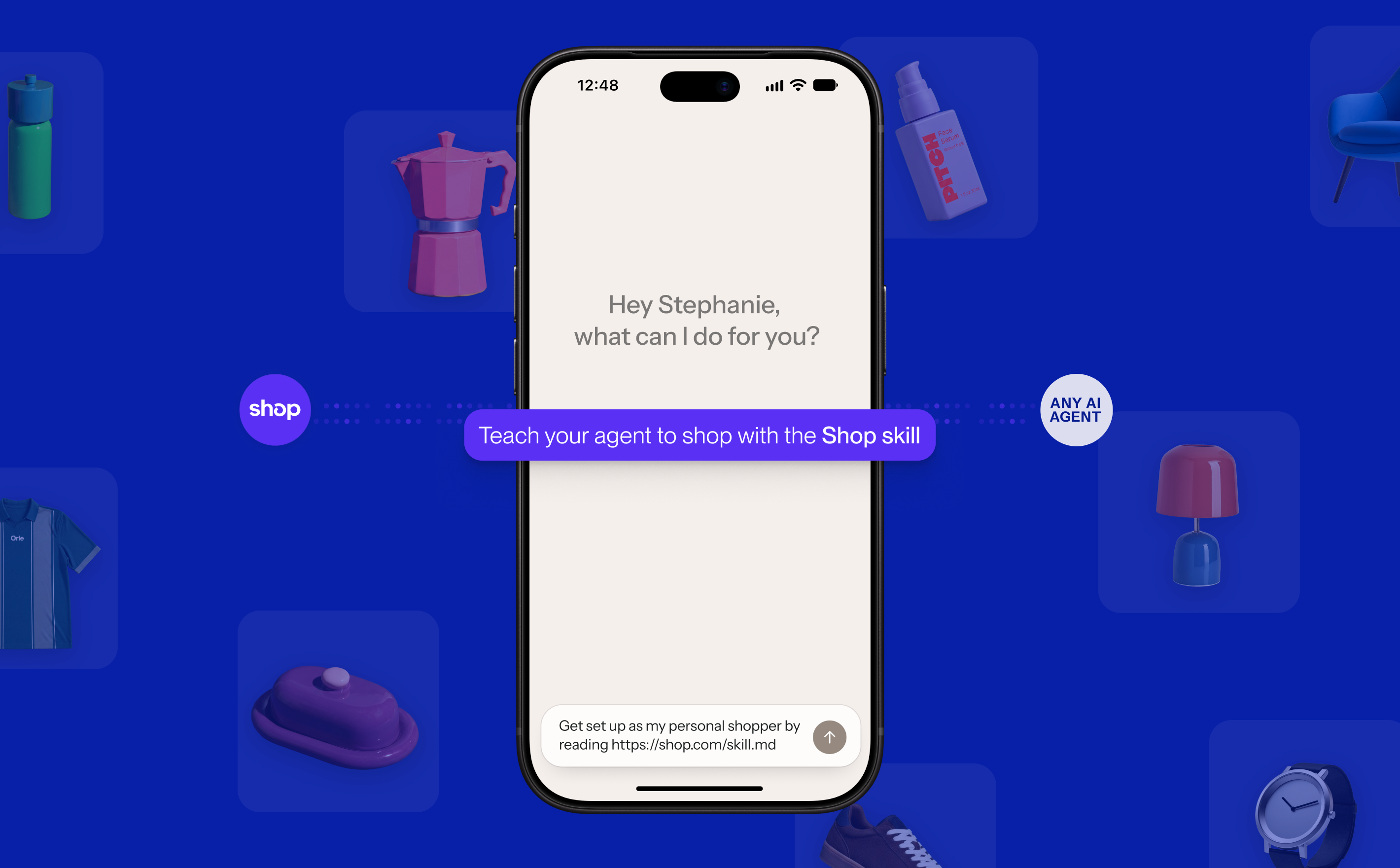
Image source: Shopify’s official Fall ’26 merchant announcement.
Three jobs, not one AI category
1. Discovery and purchasing through external agents. The shopper wants help finding a product across brands and completing a purchase. Catalog visibility, accurate product data, and supported checkout paths matter here.
2. Merchant operations. Shopify connectors let merchants manage products, inventory, orders, and performance from supported AI conversations. Sidekick handles increasingly technical admin work. Canvas, announced in early access, concerns store design. These capabilities help the person running the shop.
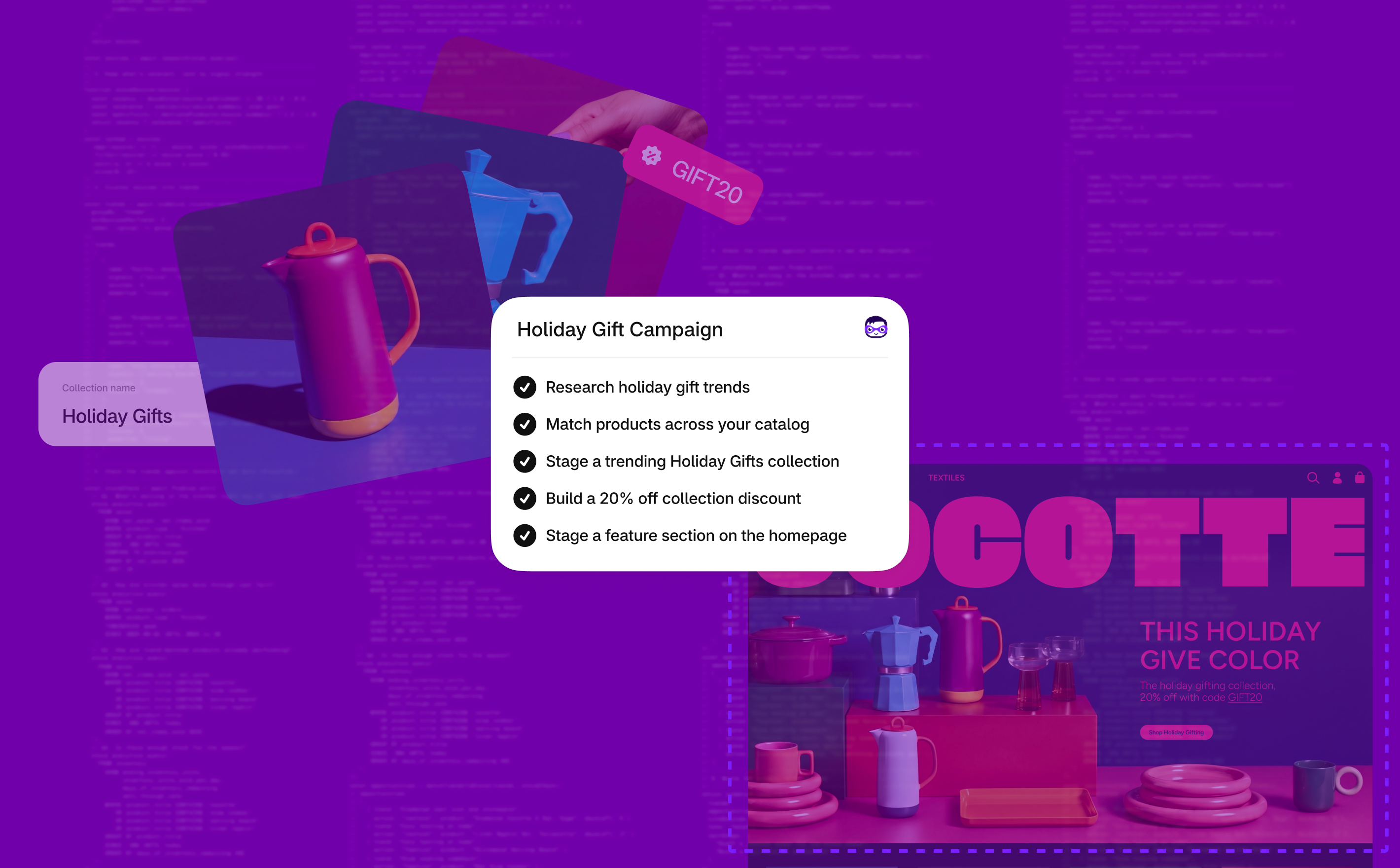
Image source: Shopify’s official Fall ’26 merchant announcement.
3. Decisions inside the storefront. A visitor comparing two backpacks may need to know which fits their laptop, what the extra price buys, and whether returns work for their destination. The job is resolving a particular buying uncertainty—not simply producing a reply.
These are useful distinctions, not permanent product boundaries. Native features can cover more of the third job over time. An independent assistant must be assessed against what your store can actually do today, not a convenient claim that Shopify “cannot do selling.”
When native may be enough—and when to test more
If your range is straightforward, product pages answer the important questions, and visitors rarely need help choosing, start with native capabilities and better content. The same applies when traffic is too limited to evaluate an extra tool reliably. More software can add cost and maintenance without removing meaningful friction.
Consider a focused storefront-assistant test when you see recurring, unresolved purchase questions: confusing variants, compatibility requirements, difficult comparisons, or policy uncertainty before checkout.
First ask whether clearer product pages, filters, or existing tools would solve the problem more simply. Then test the assistant against representative questions. Does it use current facts, respect promotion rules, admit uncertainty, and hand off appropriately? A tool that gives confident but wrong advice creates a new problem.
Three things to do before installing anything
Clean up product information. Make sizes, materials, compatibility, variant differences, prices, and availability consistent. Better inputs help both native and independent experiences.
Check eligibility and published store facts. Review Catalog status and channel requirements in the admin. Audit shipping, returns, and other knowledge-base facts. There is an important detail in Shopify’s knowledge-base documentation: storefront-scan suggestions remain unpublished until published, but facts linked to admin data can be published when created. Do not assume everything waits in a draft queue.
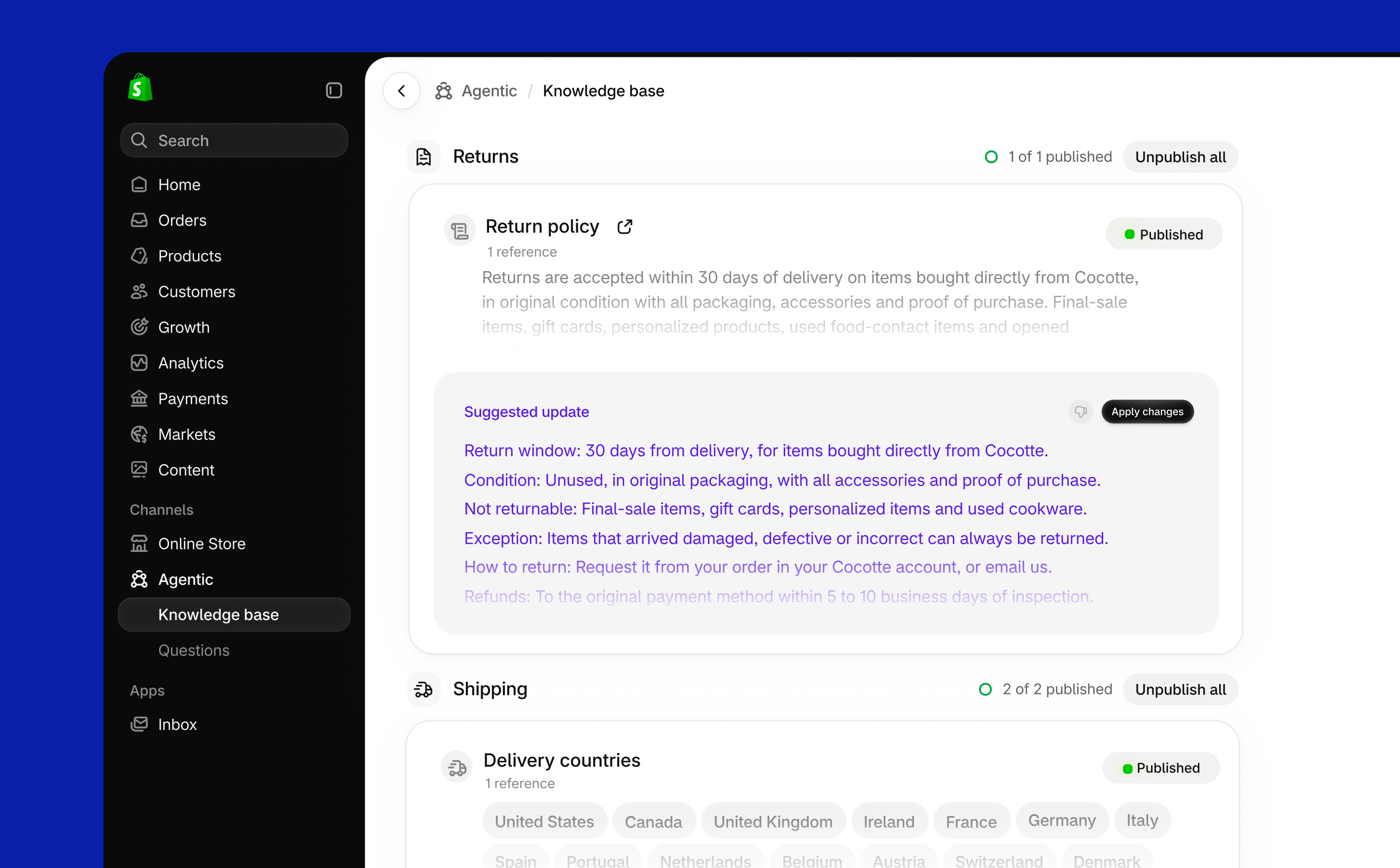
Image source: Shopify’s official Fall ’26 merchant announcement.
List unresolved shopping questions. Use support questions, onsite searches, and observed shopping friction. Pick one problem and define what a correct, useful answer looks like. That becomes your test brief, regardless of vendor.
Measure what changed, not how much the bot talked
An install proves deployment. Conversations show usage. Add-to-cart events suggest progress. Completed orders matter more—but orders after a conversation are not automatically orders caused by it. High-intent shoppers may be more likely to ask questions in the first place.
Where feasible, randomly assign eligible visitors to the current experience or the assistant experience, keeping assignment consistent. Define the primary outcome and sample-size requirements before starting. Compare purchase conversion or revenue per eligible visitor, with add-to-cart rate as a diagnostic—not a substitute for sales.
Watch margin after discounts, cancellations, returns, response accuracy, page performance, and support workload. Include subscription and operating costs. Avoid stopping as soon as a result looks positive. Low traffic may leave the outcome inconclusive; a before-and-after comparison can offer clues but is weaker causal evidence.
“Assisted revenue” is useful attribution. It is not, by itself, incremental revenue.
Where Upsello fits
I’m building Upsello, an AI shopping assistant for Shopify merchants. That gives me an interest in this category—and a reason to be explicit about the standard: a useful product must earn its place beside Shopify’s native capabilities.
The question is not whether you need “more AI.” It is whether shoppers still face a specific decision your current experience does not resolve, and whether another tool can improve the outcome enough to justify its cost.
Start with that question. If a gap remains, consider Upsello as one option to evaluate against the same test brief—not as a replacement for getting the foundations right.


