

Short answer: Black Friday 2026 falls on November 27 and Cyber Monday on November 30. Before then, make sure every answer a shopper needs before ordering comes from a fact your store can stand behind: the right variant, whether the offer applies, delivery options and the relevant return terms. That applies to your product pages, your support team, any on-site AI assistant and the outside AI agents that now read your catalog.
Surveys from Shopify, Microsoft Advertising, Criteo and DHL point the same way: many shoppers plan to use AI during the holidays, and shipping is a common drop-off point. The surveys set the agenda; your own customer questions should choose the work.
| Area | Source of truth | Owner | Test before the sale |
|---|---|---|---|
| Product details | Current variant record | Product/catalog owner | Real selection task, then retest with a variant out of stock |
| Promotion rules | One approved rule set | Promotion owner | Eligible cart, excluded item, below-threshold cart, blocked combination |
| Delivery and returns | Live shipping settings and policy | Shipping/ops owner | One destination, method and sale item followed to final terms |
| Human help | Named queue and coverage plan | Support lead | Missing-fact question and policy exception picked up by staff |
What the 2026 shopper signals mean
In Shopify's 2026 Global Holiday Retail Report, 65% of surveyed shoppers expected to use AI for at least one shopping task during the holiday season. That gives merchants a useful planning signal: prepare for questions about what to buy, how products differ and which option fits a specific need.
| Shopify survey finding (2026 holiday season) | Share |
|---|---|
| Shoppers who say they'll use AI for at least one shopping task | 65% |
| Regular AI users more likely to choose an indie brand than last year | 71% |
| Regular AI users choosing more products because they feel personal, intentional or considered | 81% |
| Shoppers who choose the best version for their needs, even if not the cheapest | 35% |
| Shoppers who say they trusted an AI agent to buy on their behalf | About one-third |
Source: Shopify, "Welcome to the first holiday season of the agentic era", Oct 6, 2026, citing the 2026 Global Holiday Retail Report.
The last row matters for store preparation: shoppers use AI to research, but most still make the final decision themselves -- so the facts on your own pages have to close the sale.
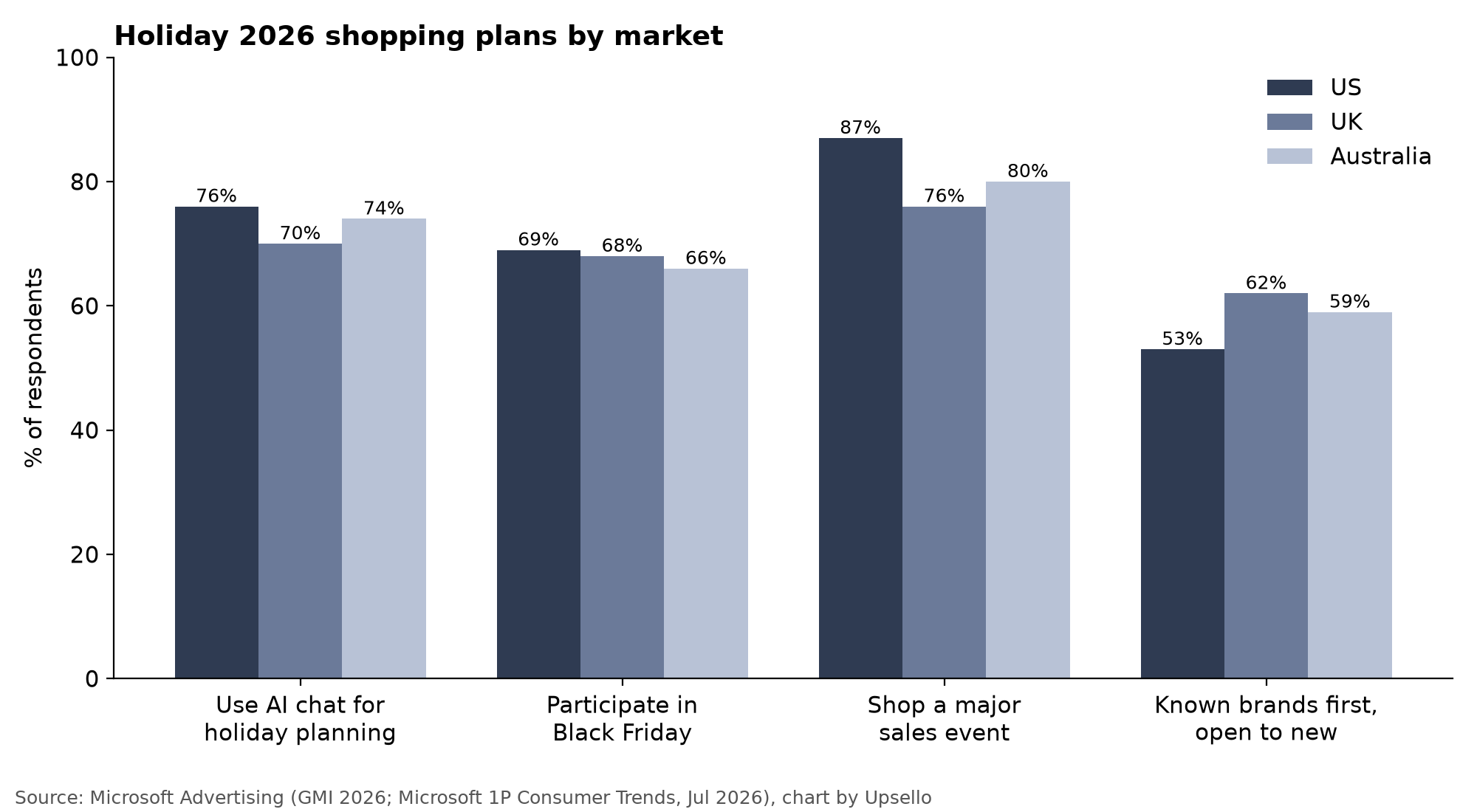
Microsoft Advertising's September 2026 article, based on July 2026 research, adds a view across three markets:
| Reported shopping plan | US | UK | Australia |
|---|---|---|---|
| Plan to use AI chat for holiday planning | 76% | 70% | 74% |
| Plan to participate in Black Friday | 69% | 68% | 66% |
| Intend to shop a major sales event | 87% | 76% | 80% |
| Start with known brands, but open to new ones | 53% | 62% | 59% |
Source: Microsoft Advertising, Sep 2026; GMI 2026 Holiday Survey Insights (Global) and Microsoft 1P Consumer Trends research, Jul 2026 (US n=1,024, UK n=519, AU n=310).
The practical question is what help people want. In Criteo's September 2026 Shopper Survey, 59% of consumers said they find AI-powered chatbots helpful in answering their questions when shopping online. The figure combines respondents who strongly or somewhat agreed. It describes perceived usefulness in online shopping generally, beyond Black Friday.
| Agree (strongly or somewhat) | Global | US | UK | Canada | Australia |
|---|---|---|---|---|---|
| AI-powered chatbots are helpful in answering my questions when shopping online | 59% | 55% | 59% | 49% | 64% |
| Comfortable with AI personalizing my shopping experience | 51% | 49% | 52% | 43% | 55% |
| Trust product recommendations received through AI on websites | 46% | 47% | 50% | 40% | 54% |
| Prefer retailers to use AI for more personalized product recommendations | 44% | 45% | 46% | 35% | 49% |
Source: Criteo Shopper Survey, September 2026 (N=9,445); published Oct 22, 2026. Selected markets shown.
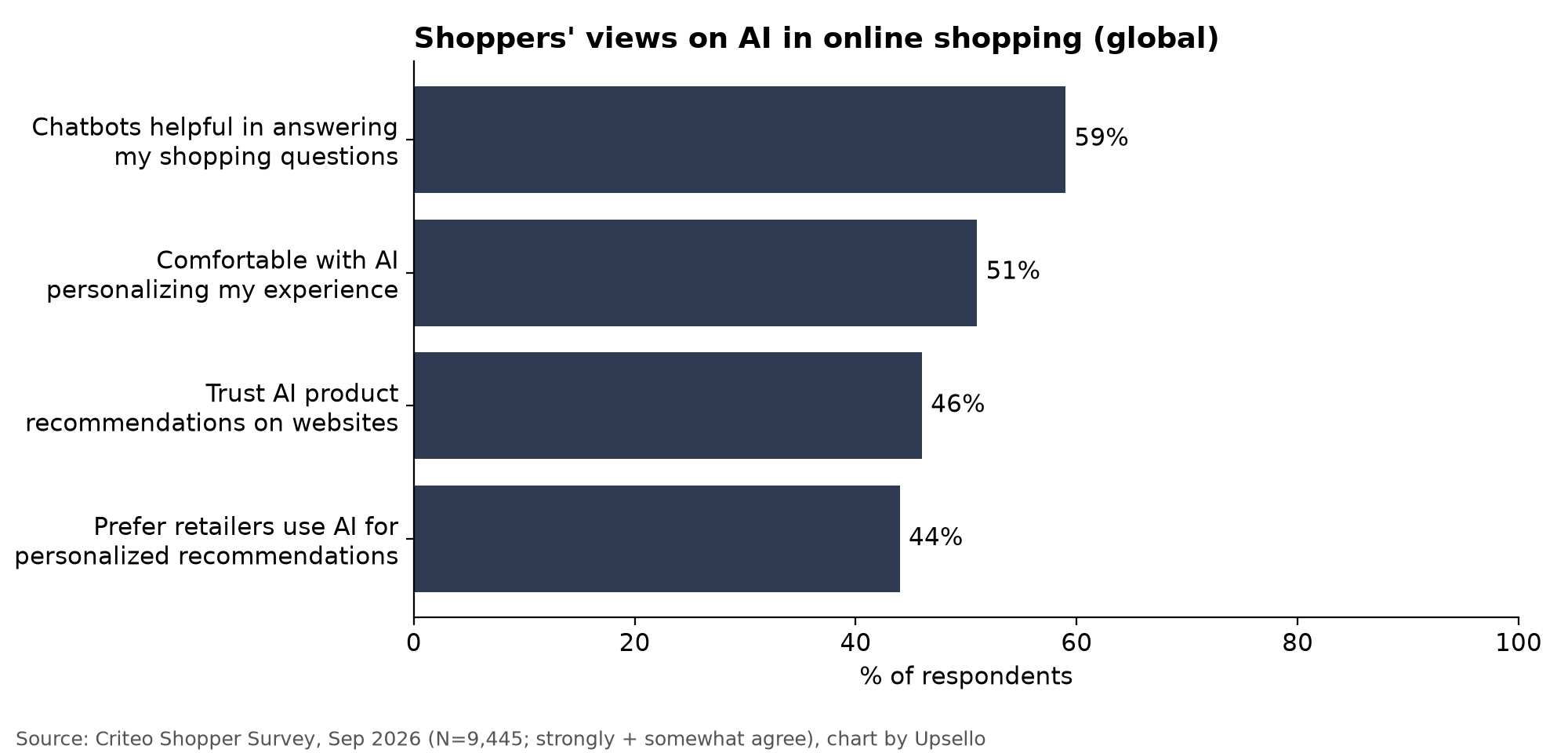
Helpfulness runs ahead of trust: more shoppers find chatbot answers useful than trust AI product recommendations. Criteo also reports concerns about privacy (50%) and misleading information (48%) -- a reason to keep every answer tied to a checkable store fact.
These studies ask different questions, so their percentages should stay separate. Use them to set a preparation agenda, then turn to your own customers' questions to choose the work.
The planning studies describe AI research that can begin before a store visit. Inside your store, define a narrower job: answer product and policy questions using information the assistant can actually access.
Review recent support messages and product questions. For each recurring concern, identify the fact needed to answer it and where that fact lives. "Will this fit?" may need a variant's measurements; "Can I return the gift?" needs the policy for that item and market. Prioritize gaps that affect heavily promoted products or keep reappearing in conversations. This gives your team a manageable set of answers to prepare before expanding to more of the catalog.
Check what outside AI agents can read
Some AI shopping now happens before a shopper reaches your site. Shopify says Shopify Catalog structures product data so agents can read it, and Agentic Storefronts put products in front of shoppers in AI channels such as ChatGPT, Google and Muse. Those agents can only repeat what your catalog states, so the same product, offer and policy facts below serve both channels.
Before the sale, confirm your active AI channels in Sales channels > Agentic. Check your Black Friday offers against the requirements of each channel and test them at checkout. For example, Shopify documents support for automatic discounts and discount codes in Google AI Mode and Gemini's direct checkout. A theme-only sale banner is not a checkout discount.
Make product answers specific enough to support a decision
Good product advice shows why an item fits what the shopper needs. Start with items that have several variants, draw frequent questions or play a large part in your Black Friday sale. List the facts that could change a choice: size, materials, included parts, care needs, price and stock.
Consider a hypothetical shopper looking for a desk organizer under $40. Their shelf is 30 centimeters wide, with 25 centimeters of space above it. A description such as "compact storage for any workspace" cannot establish that the item fits. A useful answer needs the size and current price of the exact option, plus the facts that set it apart from the others.
Shelf depth is still missing. A careful response could narrow the options using the known measurements, then ask for the depth before confirming a fit. That extra question has a clear purpose: it resolves a condition that the product description alone cannot settle. Picking the smallest model without checking it would leave the same gap.

Give these facts a clear home in your catalog, and choose which record staff should use if two sources disagree. For example, a product owner should resolve a mismatch between an old description and a current variant record before either appears in an answer. Our guide to the product data behind reliable recommendations explains how to organize that work.
Upsello's guided recommendations use connected store and catalog information to help guide product choices. Define what it should answer from your store's available data and setup. Then run a real selection task. Check the suggested variant against every stated need, and trace each reason back to the current record.
Repeat the test after marking that variant out of stock or removing a key measurement. The response should reflect the change, suggest another item it can check or explain what it needs to confirm. A fluent answer that ignores the missing fact still needs work.
Make Black Friday offers answerable
A sale banner can communicate the headline offer while leaving the shopper unsure whether it applies to their cart. Give your team one approved set of rules covering the start and end time, time zone, eligible products, customer or market restrictions, minimum spend, exclusions and rules for combining offers.
Put the conditions where the question arises. If bundles are excluded from a promotion, explain that alongside the offer and in the answer a shopper receives. A link to a long terms page is useful for detail, but the immediate answer should still explain the condition that changes the outcome.
Test the explanation against checkout. Use an eligible cart, an excluded item, a cart below the threshold and a combination of offers that cannot be used together. The wording on the product page, the support answer and the result at checkout should agree. If they differ, ask the promotion owner to fix the source rule or the setup before publishing the answer.
Separate explaining an offer from taking an action. An assistant can be instructed to describe an approved discount; applying one requires the right permissions and a confirmed result. Build that distinction into the response so a shopper knows what they still need to do. When the offer does not apply, explain the reason and any approved next step. A made-up replacement code creates another problem for the team to solve.
Answer delivery and return questions before the last step
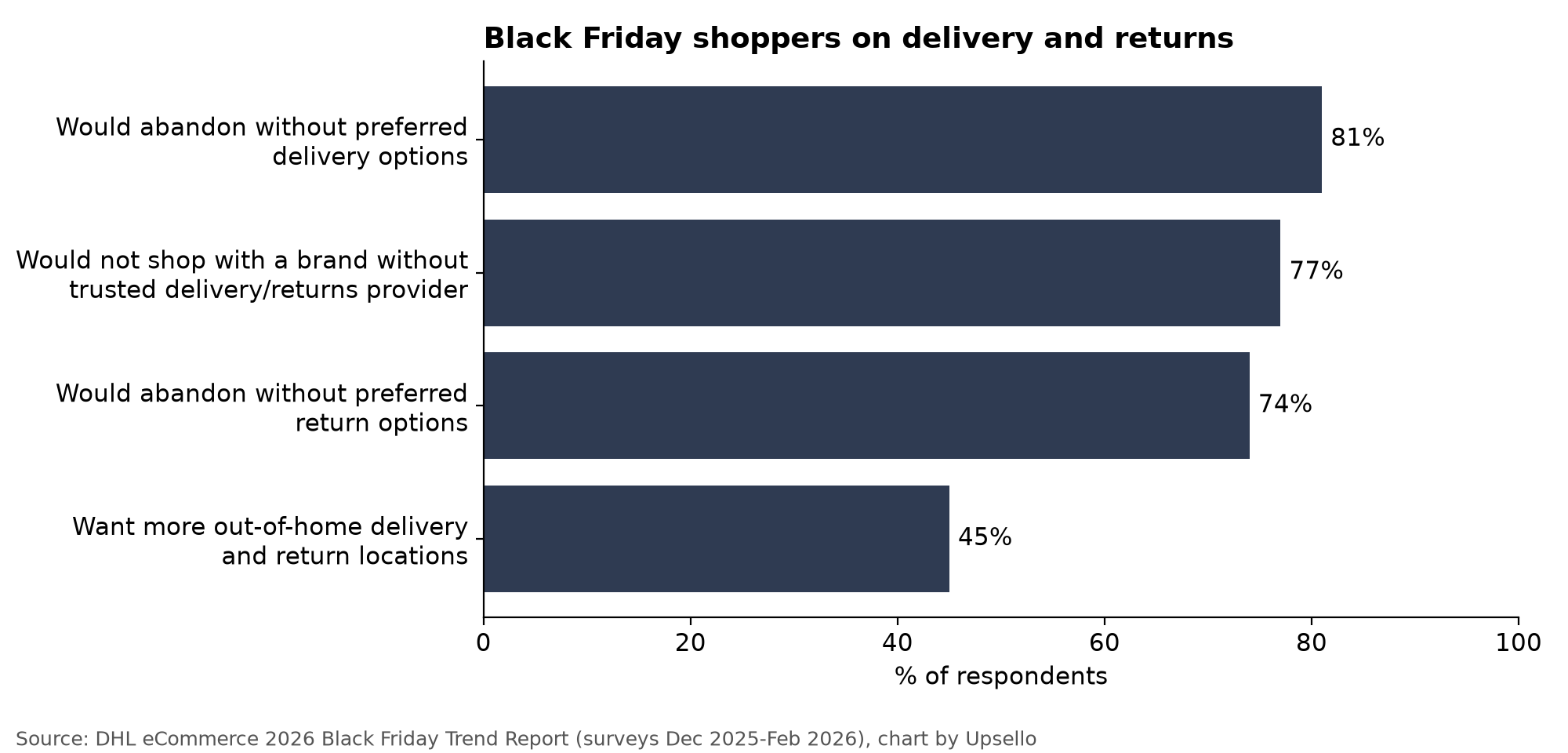
DHL's 2026 Black Friday report says one in three Black Friday shoppers named shipping options as the stage where they were most likely to abandon. This is shoppers' stated likelihood, gathered before the 2026 event. For store preparation, it points to a specific task: make the delivery choices and their conditions easy to check before payment.
| DHL finding: Black Friday shoppers | Share |
|---|---|
| Most likely to abandon at the shipping-options stage | 1 in 3 |
| Would abandon without their preferred delivery options | 81% |
| Would abandon without their preferred return options | 74% |
| Would not shop with a brand if they did not trust its delivery or returns provider | 77% |
| Want more out-of-home locations for deliveries and returns | 45% |
Source: DHL eCommerce, 2026 Black Friday Trend Report; surveys Dec 15, 2025 -- Feb 11, 2026. Self-reported intentions, not observed behavior.
Start with what varies by destination. A shopper needs the methods available to their address, the charge or free-shipping condition, and the delivery estimate that applies to that method. A general "fast delivery" message leaves those decisions open. If an item ships separately or needs extra handling time, make that condition part of the answer.
A gift deadline adds another layer. Take a real destination and ask whether an order placed near your published cutoff can arrive by the requested date. Check the answer against the current method, cutoff time and any conditions your shipping team has approved. When the available information supports only an estimate, present it as an estimate and offer a human check if the date is essential.
Returns deserve the same care. Confirm the policy for sale items, gifts and any relevant regional or product exceptions. A shopper asking about a discounted item should receive the terms that apply to that item, including who pays return shipping and how to request help.
Keep the policy version shared by your storefront, team and assistant up to date as the promotion changes. Our guide to checkout conversations that address purchase friction shows how to keep these answers tied to the concern in front of you. For Black Friday, the useful test is concrete: choose a destination, method and sale item, then follow the answer through to the actual terms a customer will see.
Make human handoff clear when questions need judgment
Some questions need judgment. A missing measurement, conflicting price records or a request for a return exception should have a clear route to someone who can resolve it. Decide the route before the busy period, including who owns the case when the usual team is offline.
A helpful handoff carries the conversation forward. Give the employee the shopper's question, the relevant product or order reference where permitted, the information already checked and the point still unresolved. This lets them make a decision from the same context, rather than asking the shopper to explain the whole problem again.

Upsello's pricing FAQ says it can handle repetitive product, policy and recovery conversations while complex cases move to your existing support team. For your store, confirm the receiving inbox or queue, staff coverage and the context that arrives with the case. Test a missing-fact question and a policy exception, then have an employee pick up both.
The customer should also know what happens next. Give the approved contact route or response expectation, especially outside staffed hours. Keep the case open until the responsible person or system confirms the result. A message saying that a request has been passed on should match a handoff the team can actually find.
Check the whole shopping journey before the sale
Before the sale, bring the owners of product data, promotions, shipping and support together around the same set of cases. Record the source used, the last check, the result and any issue still open. This gives each owner a concrete decision: approve the answer, correct the data or keep that topic with the human team for now.
Run the shopper journey on a phone as well as a desktop. Check that the customer can read the answer, open the relevant policy, choose the intended variant and reach checkout. Then repeat the cases most likely to change during the sale, such as a stock update or an expiring offer.
During Black Friday and Cyber Monday, review answer accuracy, unresolved questions and handoffs alongside checkout resumption, orders, returns, complaints and margin. An order after a chat is a useful record of that journey, but it does not show how many extra orders the chat caused. Where traffic allows, randomly assign eligible visitors to the change or a control group, and track other changes to offers or campaigns. Treat nonrandom comparisons as directional signals rather than proof of extra sales.
Use the results to improve the source information and the scope of the assistant's job. Repeatedly unanswered questions identify a practical next piece of work for the team.
Start today with one promoted product and the questions a shopper could ask from selection through delivery. Resolve the missing facts, verify the answers and assign the exceptions. If you want to plan guided selling, support or recovery workflows around that information, discuss your store's Black Friday workflows with Upsello.
FAQ
What should I fix first? Your most promoted product: its variant facts, the offer rules that apply to it, delivery options to your top destinations and its return terms.
What does Upsello cost? See current plans on the Upsello pricing page.


