
 Language

On October 16, Vercel and Shopify announced that Vercel Shop is generally available, under the headline "agents are first-class shoppers." It raises a question every Shopify merchant will eventually ask: do I need to move my store to something like this to get found by AI?
For most stores, the answer is no. But the announcement still matters, and the way it matters shows where your effort should go next. I've spent more than ten years in quant and data science, and the habit that stuck is to separate the signal from the packaging before deciding anything.
What Vercel Shop is, and what it isn't
Vercel Shop is an open-source Next.js storefront template built on Shopify's rebuilt Hydrogen SDK. It replaces your frontend. Shopify still runs the catalog, cart, payments and checkout. That's the key difference from Medusa: Medusa is an open-source commerce backend that replaces Shopify itself.
According to Vercel, the template bundles three things:
- Machine-readable product pages. The same URL serves a visual page to people and clean data (price, availability, options) to agents, along with structured data and sitemaps.
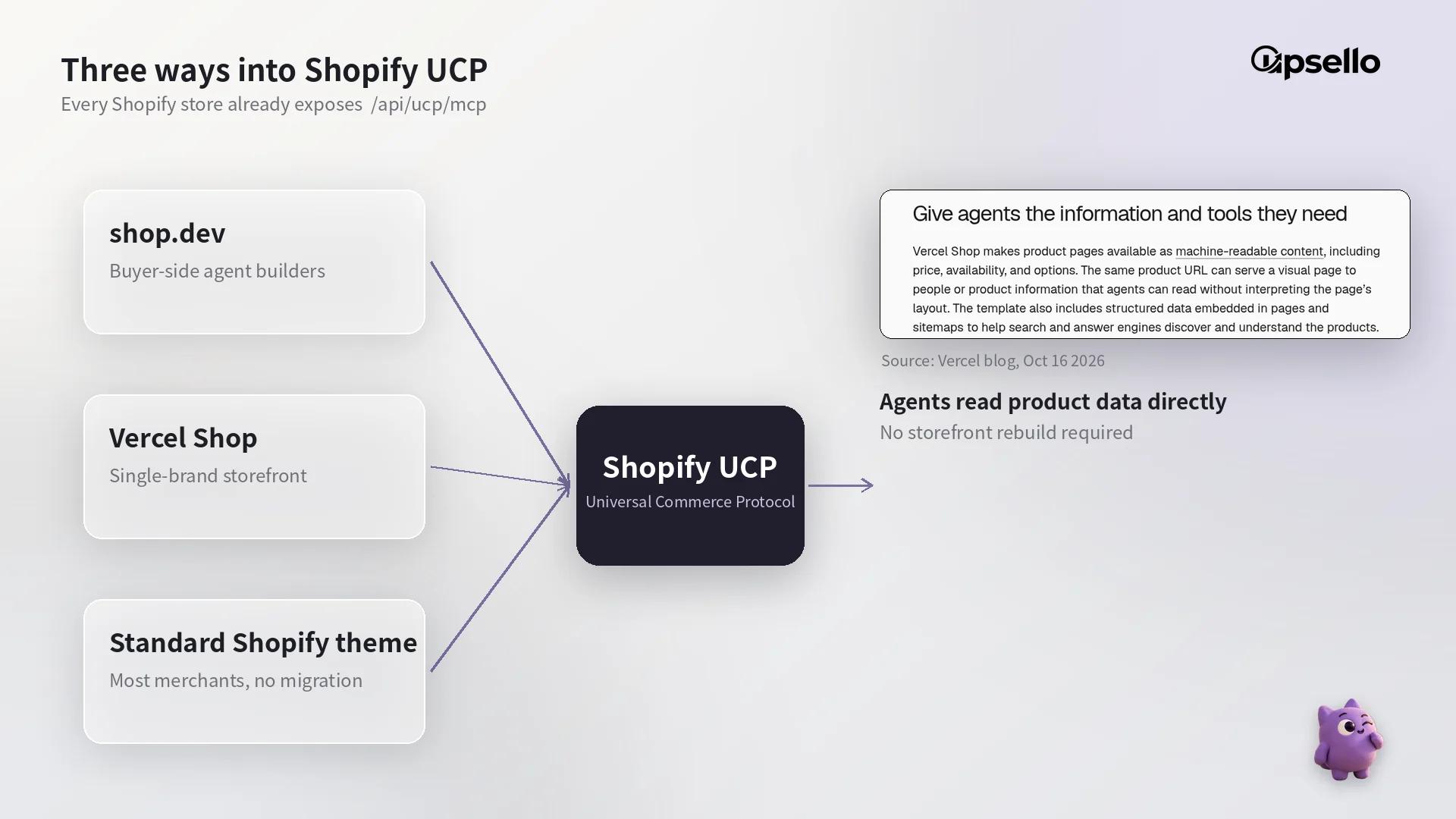
- UCP over MCP on the merchant's own domain. UCP is the Universal Commerce Protocol, which Shopify co-developed. It lets agents search, check availability, build a cart and get a checkout link.
- A built-in shopping assistant, powered by eve, that shares one cart with the regular pages.
Vercel also cites PAIGE, which it says saw +22% revenue and +76% conversion over Black Friday and Cyber Monday after re-architecting its platform. Read that as Vercel's claim about one brand's full re-platforming, not as a result a template delivers.
shop.dev vs. Vercel Shop: two sides of one protocol
shop.dev is Shopify's hub for developers who build shopping agents. It offers one endpoint to search over a billion products across millions of stores, plus Shop sign-in and Shop Pay for agent checkout. That's the buyer side. Vercel Shop serves a single brand rebuilding its own storefront, which is the merchant side. Both run on UCP.
The detail that matters most for ordinary merchants is in Shopify's docs. The old Storefront MCP catalog and cart tools were removed. UCP now serves them at https://{shop}/api/ucp/mcp, on the Shopify store's own domain. Shopify's agent docs describe UCP tools for catalog, cart, checkout and orders. Agent access is a platform feature, not a perk of one template.
Should you migrate to get found by AI?
For most small and mid-size merchants, no.
1. The platform already gives you most of it. Shopify is building agent access into the platform itself: UCP endpoints, the catalog that shop.dev agents search, and checkout tools. Standard themes already ship basic structured data and sitemaps. Vercel Shop packages all this more cleanly and runs fast, but that's a marginal gain on top of what you have.
2. Agents don't pick stores by framework. An agent wants complete, accurate attributes, live availability, and evidence such as reviews, Q&A and policies. It also wants signs that the rest of the web trusts you. shop.dev's own FAQ warns that "AI-inferred attributes may be missing or wrong." When your data is thin, the platform guesses for you. The fix is better data, not a new frontend.
3. Migration has real costs. A custom storefront means engineering, maintenance and template updates. Rebuilding the frontend can also disturb the URLs, redirects and rankings you spent years earning. Brands with dev teams can absorb that. Most small teams can't.
Vercel Shop makes sense for brands that want a headless frontend, have developers and need deep customization. For everyone else, it's a signal to read, not a project to start.
What the announcement really means
Shift 1: Agent shopping is now table stakes
Shopify's docs now describe agents that build carts, complete checkout (for trusted agents) and track orders. When the platform owner builds the rails, the question changes. It's no longer "will this happen?" It's "what does my store look like to an agent when it does?"
Shift 2: A basic chat assistant is now free
Vercel Shop includes an assistant inside an open-source template. For merchants who want no-code AI chat, Shopify points them to the Inbox agent in Shopify Inbox. A chat box that finds products and adds them to the cart is becoming a commodity.
I build a Shopify AI shopping assistant, so I'll be direct: if our value were "we have a chatbot," it would be heading to zero. The value has to live where a template can't reach:
- Knowing why shoppers don't buy. Conversations are full of objections like "Is this true to size?", "Will it arrive by Friday?" and "Why is this pricier than X?" Analytics shows what shoppers did. Conversations show why they hesitated.
- Acting on it. An insight that doesn't change a product page, an FAQ, an offer or a follow-up is just a report.
Shift 3: You now have two kinds of shoppers
Humans browse pages. Agents call tools. When an agent compares your product with three competitors, it decides based on what it can read and verify, and a hero banner won't sway it. Being readable and recommendable by external agents is now its own job. People call it GEO (generative engine optimization), and I think it's mostly data discipline.
How we're thinking about this at Upsello
Upsello is still an AI shopping assistant for Shopify. That hasn't changed. What's changing is that the assistant is becoming one member of a small team of agents that share one memory of the store: shopping assistant, recovery, PDP optimizer, support and insights. Now we're adding a GEO agent.
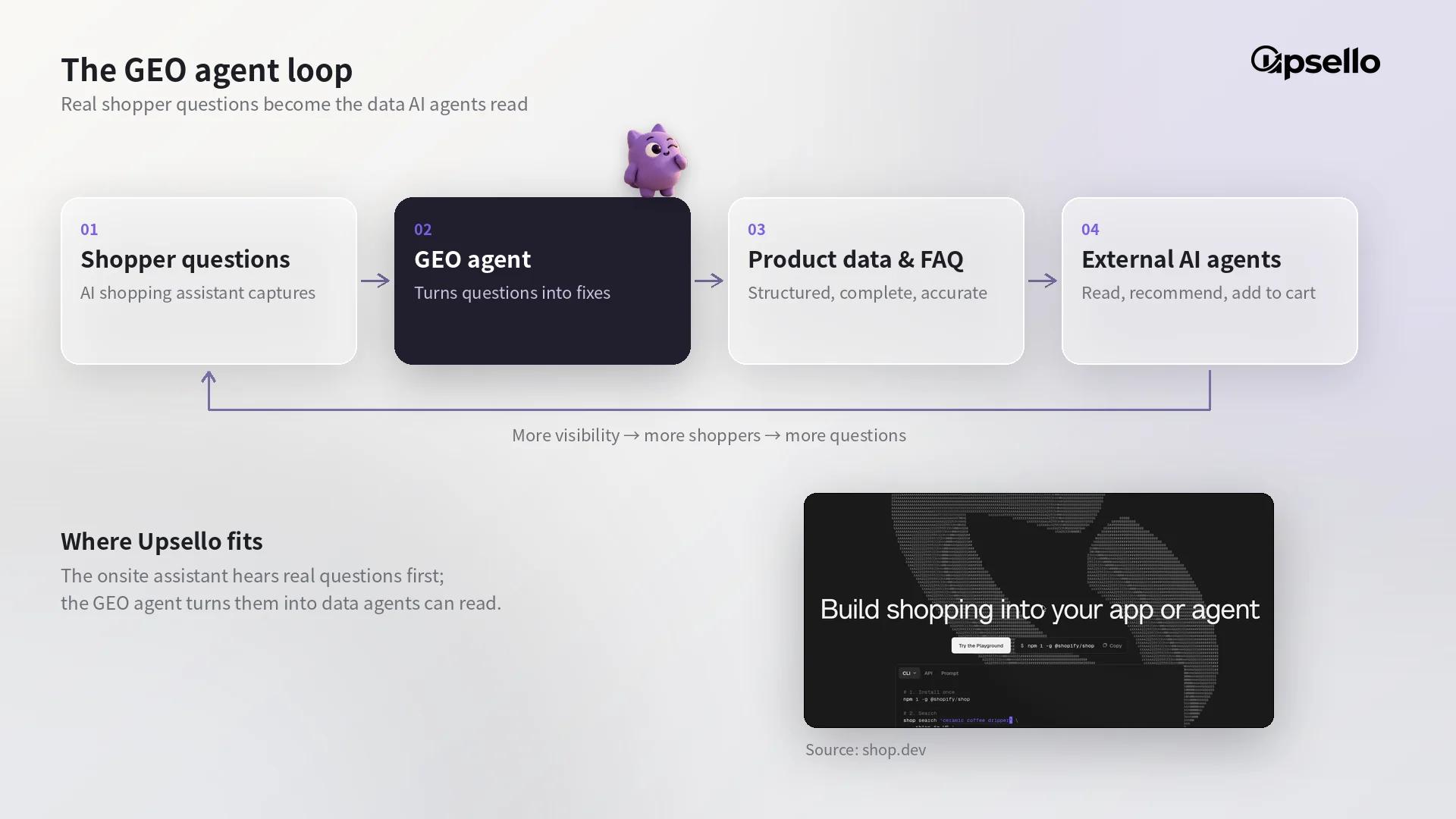
Its job is to make the store agent-ready and keep it that way:
- Audit product data the way an agent reads it. Check for sizes, materials, compatibility, use cases, shipping regions and policies, and flag gaps before an agent fills them with guesses.
- Verify the agent interfaces Shopify already provides. Confirm that an agent can search, read a product and build a cart end to end.
- Watch how AI describes the store. Ask ChatGPT, Perplexity and Google's AI features the questions your customers ask. Record whether you're mentioned, how you're described and who you're compared to.
- Feed real shopper questions back into content. This is where a Shopify AI shopping assistant gives a GEO agent an edge. The questions shoppers ask the assistant every day are the same ones agents will ask on their behalf. Each recurring objection becomes a better description, a new FAQ entry or a clearer policy, which helps the next human and the next agent.
Most GEO tools have to guess what people will ask. A store running an AI shopping assistant has the transcript. We're early here, and I'd rather share the direction than oversell a finished product.
The question I'm asking merchants
When an AI agent describes your store to a shopper right now, do you know what it says? If it got something wrong, how would you find out?
Tell me what you find. The answer will shape what we build next.
FAQ
Do I need Vercel Shop for AI agents to find my Shopify store? No. Shopify exposes agent access at the platform level through UCP, including an MCP endpoint on the store's own domain and the catalog that shop.dev agents search. Vercel Shop mainly helps brands that want a custom headless storefront.
What's the difference between shop.dev and Vercel Shop? shop.dev is Shopify's hub for developers building shopping agents across all Shopify stores (the buyer side). Vercel Shop is an open-source template one brand uses to rebuild its storefront (the merchant side). Both use UCP.
Is Vercel Shop like Medusa? No. Medusa is an open-source commerce backend that replaces Shopify. Vercel Shop replaces only the storefront. Shopify still runs catalog, cart, payments and checkout.
What should a small Shopify merchant do to be agent-ready? Make product attributes complete and correct, keep availability and policies accurate, collect real reviews and Q&A, and check how AI assistants describe your store. Then use real shopper questions to fill gaps in product pages and FAQs.


